New Food Pyramid 2026: Dietary Guidelines Resources for Professionals: References and Need to Know
The U.S. federal government has released the 2025–2030 Dietary Guidelines for Americans, marking one of the most significant updates to national nutrition guidance in decades. These Guidelines — available through realfood.gov and the official Dietary Guidelines portal — emphasize whole, nutrient-dense foods.
click to download the new guidelines
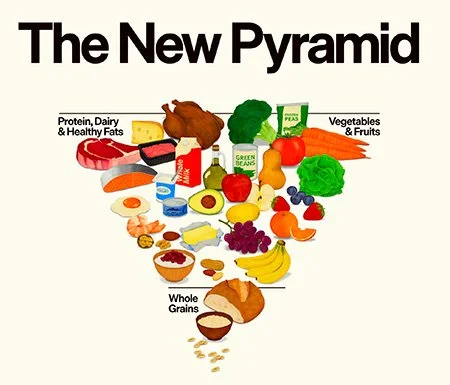
There is a lot of noise on all channels about an upside-down pyramid, the gutting of an easy-to-read MyPlate, emphasis on saturated fat in meat and dairy, and, most importantly, the affordability of groceries at the moment. Beef is priced at $16 per pound. But many people also agree that eating more whole foods is preferable to relying on ultra-processed foods and fast food. Fruits and vegetables are at the top, with no ultra-processed snacks. We have been reading all the comments on social media, and there are a million opinions on what to eat.
The health and affordability problems right now
According to the Centers for Disease Control and Prevention (CDC), from August 2021 to August 2023, about 55 % of total calories consumed by Americans aged 1 and older came from ultra-processed foods — those industrially formulated products high in added sugars, sodium, and fats and low in whole-food content. Youth consumed even more (about 62 %), while adults consumed roughly 53 %. CDC
According to the CDC’s National Center for Health Statistics, about 73.6 % of U.S. adults age 20 and older were classified as overweight or obese (BMI ≥ 25) based on the 2017–2018 NHANES data — the most recent comprehensive survey for overweight prevalence. This means roughly three-quarters of American adults carry excess weight. CDC
Heart disease is the leading cause of death both in the United States and worldwide. In the U.S., data from the Centers for Disease Control and Prevention (CDC) show that heart disease ranks first among causes of death, with the most recent statistics indicating it causes more deaths annually than any other condition. In fact, in recent years, heart disease has accounted for more deaths than cancer and all other causes, underscoring its persistent impact on public health. CDC+1
Over the past five years, food and grocery prices in the U.S. have gone up roughly 25 %–30 % overall — meaning many families now pay significantly more for the same shopping cart of groceries than they did in 2019. Beef is priced between $9 and $23 per pound, according to research from the article's publication date. Wikipedia+1
At their core, the Guidelines promote eating real, minimally processed foods and provide flexible guidance that can be adapted to fit individual tastes, cultural traditions, and budgets. Eat Real Food
Overview: What the New Guidelines Say
Pros: According to realfood.gov, the new guidance encourages:
Real, whole foods as the foundation of healthy eating — foods that are recognizable and minimally processed. Eat Real Food
Protein in every meal, from diverse sources including seafood, poultry, meats, eggs, beans, lentils, nuts, seeds, and soy. Eat Real Food
Vegetables and fruits in a wide variety of colors and forms, prioritizing freshness and minimal processing. Eat Real Food
Whole grains over refined carbohydrates. Eat Real Food
Healthy fats from whole foods like nuts, seeds, olives, avocados, and naturally occurring fats in dairy and animal proteins. Eat Real Food
Avoiding added sugars and highly processed foods with little nutritional value. Eat Real Food
You can read the full Dietary Guidelines document — and access tools, serving guides, and scientific appendices — at RealFood.gov and the official Dietary Guidelines website. Dietary Guidelines
Cons:
Many registered dietitians on social media report confusion around affordability messaging and express concern that the new pyramid may be misinterpreted. Specifically, the long-standing guidance to limit saturated fat to no more than 10% of calories risks being interpreted as recommending full-fat dairy and placing meat at the center of the plate. In addition, the framework lacks clear guidance on fiber intake, removes explicit limits on alcohol, and lacks sufficient evidence to justify eliminating all food color additives. The whole milk recommendation does not leave any options for those wanting a heart-healthy diet with skim milk or for plant-based milk when milk is not tolerable or desirable, like the new school lunch guidelines. Read the AND position paper here. Read Marion Nestle’s take here.
Bottom Line: Supporting Science-Based Nutrition
We wholeheartedly support evidence-based nutrition guidance that helps people thrive. The recommendations to eat whole, nutrient-dense foods and focus on dietary patterns — rather than single “magic” foods or nutrients — align with a large body of nutrition science showing that diets built around unprocessed foods are associated with better health outcomes. Eat Real Food
We also support the work of science-led organizations such as:
Academy of Nutrition and Dietetics (AND) — advocating for food choices that support lifelong health based on peer-reviewed science. Read their position paper here.
American Heart Association (AHA) — focused on reducing cardiovascular risk through diet quality. AHA
American Diabetes Association (ADA) — promoting individualized, evidence-based eating patterns for metabolic health.
World Health Organization (WHO) — which emphasizes a balanced diet rich in fruits, vegetables, whole grains, and limits on salt, sugar, and saturated fats. WHO
These organizations share core principles with the new Guidelines: eat nutritious, whole foods; limit added sugars, sodium, and excess saturated fat; and tailor eating patterns to your personal and cultural preferences.
Here is what the committee says about ultra-processed foods and recent research
Food processing is a broad term that describes the physical, chemical, and/or thermal treatment of foods to improve safety, quality, and shelf life. A number of studies have reported a link between the consumption of extensively processed foods (i.e., ultraprocessed) and increased risk of weight gain, cardiometabolic impairments, and overall mortality 1,2. The potential adverse health effects of processed foods is of particular concern in countries like the US, where over 50% of daily calories may come from ultraprocessed foods 3.
1. Sullivan VK, Martínez-Steele E, Garcia-Larsen V, Rebholz CM. Trends in Plant-Based Diets among United States Adults, 1999–March 2020. The Journal of Nutrition. 2024;154(12):3575-3584. doi:10.1016/j.tjnut.2024.08.004
2. Gallup Inc. In U.S., 4% Identify as Vegetarian, 1% as Vegan. Gallup.com. August 24, 2023. Accessed September 7, 2025. https://news.gallup.com/poll/510038/identify-vegetarian-vegan.aspx
3. Capodici A, Mocciaro G, Gori D, et al. Cardiovascular health and cancer risk associated with plant based diets: An umbrella review. PLOS ONE.2024;19(5):e0300711. doi:10.1371/journal.pone.0300711
Free Printable Handouts
Want more like this?
Browse our full library of free printable nutrition handouts — charts and worksheets on MyPlate, the 2026 food pyramid, protein, sodium, food labels, and more. Download and use them today. No sign-up, no watermark.
Browse free handouts →Nutrition Education Store
Look What's New in Our Store