The American "Diet"
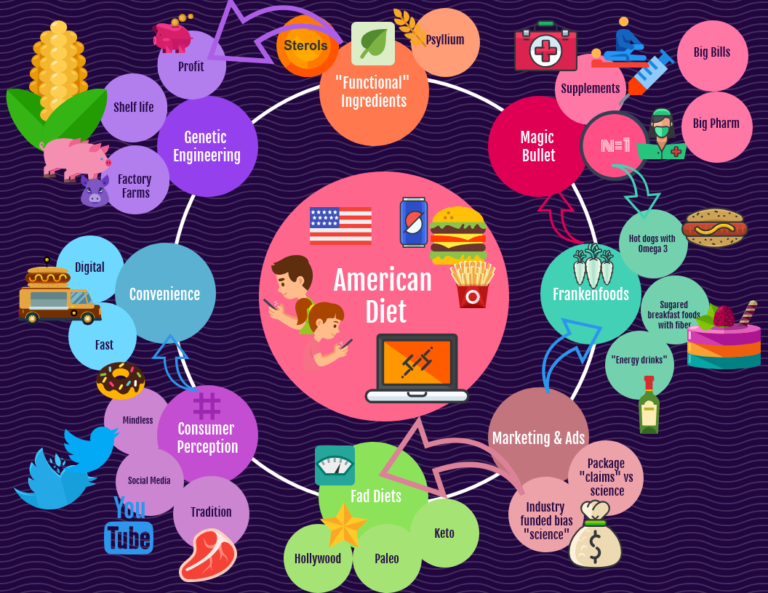 Has the "age of Nutritionism" (coined by Michael Pollen) really improved our eating? It sure has caused a flurry of activity from social media to diet books to marketing and shopping habits. I have enjoyed recording many of the greatest issues of our times after 20 years of publishing on this platform.I took a design thinking approach and made a pinup board with all of the topics regarding food and nutrition for today's consumers. Most health educators deal with all of these items on a regular basis but to see it in a diagram makes one realize how much food, nutrition, consumer attitudes, spending habits, and health statistics add up into a really big and complex picture. My first step was to organize news and topics into categories ranging from farmers to food manufacturers to consumer habits to social media. Then I made a reflective map of all of the topics and subtopics which really make up our American Diet. We consume a lot more than food when we are thinking about food and nutrition.But then I used the concepts from the Institute for the Future and made a big spreadsheet of all of the ways we need to improve to have a better future for our planet, our food supply, our health, and our quality of life. I decided to use those to do a makeover for my American diet diagram. Social media can help us to collaborate more and have one goal as a global team. Science can guide farmers and food manufacturers to make and produce nutritious and sustainable foods in an efficient manner with more plant foods. Health care can focus on keeping people well instead of battling the big beast of chronic disease. Food packages can explain the real and science-based benefits of food. And chefs can certainly plan an important role to work on taste and manufacturing processes so that people can enjoy what they eat. The HAPIfork is a wonderful tool mentioned in the IFF Seeds of Disruption map and I was able to find its real link here. https://www.hapilabs.com/product/hapiforkMy big takeaway is that we do have a huge system that is out of control, but we also have the tools and the knowledge to fix it. We have to be science-based and we have to put the health of the people and the planet before profits.
Thank you for reading!
Judy Doherty, BS, PCII[shopify embed_type="collection" shop="nutrition-education-store.myshopify.com" product_handle="2020-hot-topics"]
Nutrition Education Store
Look What's New in Our Store