

CDC Report Tells 69% of Americans to Cut Salt Intake
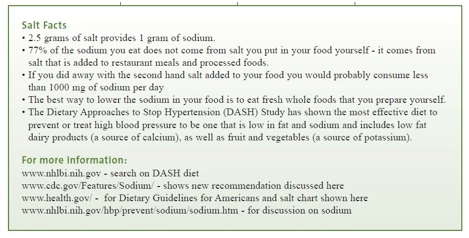 On March 26, 2009 the Center for Disease Control (CDC) released a new report telling all Americans over 40 years of age to limit their sodium intake to no more than 1,500 mg per day.
They note that previous guidelines said all adults should limit sodium to no more than 2,300mg per day.The new report also said all people younger than 40 years old with high blood pressure should reduce their sodium intake to no more than 1,500mg per day as should all African-Americans because they are at higher risk of developing hypertension.The report notes that 69% of American adults now fall into one of these 3 groups, which the CDC report says puts them "?at high risk from health problems associated with too much sodium." The report also notes that 75 to 80% of the salt in the average American's diet now comes from processed and restaurant foods. Only about 10 to 15% of the salt the average American consumes is added by one's own hand. Less than 10% of salt for the average American occurs naturally in foods. Since the average American consumes about 4,000mg of sodium daily or 10 grams of salt it is clear that salt added to the food by others ("second-hand salt") needs to be dramatically reduced. This will not happen unless the Food & Drug Administration reclassifies salt and starts restricting the amount the food industry is allowed to add to food.1Certainly the CDC took an important step in warning most Americans about the dangers of too much salt.However, it makes little sense to imply that Americans under 40 years of age without hypertension would not also benefit from limiting sodium to no more than 1500mg/day. Why? The evidence is now overwhelming that hypertension is usually a late stage symptom of salt toxicity, much as emphysema is a late stage development from tobacco smoke toxicity or a cirrhotic liver is a late stage development of excessive alcohol intake.We don't wait until age 40 or the development of emphysema or cirrhosis to tell people smoking or drinking heavily are dangerous.Research in animals has shown that excess dietary salt damages the artery wall long before blood pressure is increased. Indeed, rats like people who consume excess salt show an increased growth of smooth muscle cells and fibrous proteins in their arteries. This thickens and stiffens arteries throughout the body and especially arteries in the brain, kidneys, and heart.2Increased salt intake increases blood volume and shear stress on the artery. This leads the endothelium to increase its production of TGF-beta and NO independently of its effect on blood pressure.3 Increased TGF-beta and NO released from the endothelium leads to an overgrowth of smooth muscle cells and fibrous matrix proteins in the surrounding artery wall. Over time this causes arteries throughout the body to thicken and become stiff.Most doctors believe the thickened, stiff arteries, seen in nearly all their older patients, are largely the result of aging because the BP medications like diuretics do little to stop it. However, research now strongly suggests that this process, which leads to an elevated pulse pressure and isolated systolic hypertension, is largely the result of the long-term consumption of a diet with far too much salt.Excessive TGF-beta produced in the kidney's glomeruli in response to high salt feeding. Giving rats on a high-salt diet a diuretic did not reduce the excessive TGF-beta suggesting that diuretics may lower BP but are not stopping the disease process.
By James J. Kenney, PhD, RD, FACNReferences:1.www.cdc.gov/Features/Sodium2. Am J Physiol Renal Physiol. April 2009;doi:10.1152/ajprenal.00027.20093. Hypertension 2002;39:239-44
Nutrition Education Store
Look What's New in Our Store

Build-a-Plate Teaching Kit with Food ModelsView in store →

Meet the Kernel Whole Grain Replica BundleView in store →

Lunchtime Hero 3D Award Figure + Activity GuideView in store →

How Much Sugar? Test TubesView in store →

NEW! 3D-Printed Sugar Cubes: Stack the SugarView in store →

How Much Salt? Test TubesView in store →

How Much Fat? Test TubesView in store →

The New Pyramid Poster 2026 (18"×24")View in store →

New 2026 Food Pyramid TearpadView in store →

MyPlate Handout TearpadView in store →

Food Label Math Poster (18"×24")View in store →

Sip Smart Hydration TearpadView in store →

Are You Drinking Candy? Banner on Stand (24"×67")View in store →

MyPlate Portion Plates (Pack of 10)View in store →

Fruit & Vegetable Pens (Pack of 10)View in store →

Fruit-Shaped Note Pads (Pack of 10)View in store →

NEW! Eat Real Food Wristbands (Pack of 20)View in store →

NEW! Habit Stack Wristbands (Pack of 20)View in store →

NEW! Are You Drinking Candy? Wristbands (Pack of 20)View in store →