Chromium Supplements Don?t Work
Chromium supplements are now being taken by millions based on claims that they improve insulin sensitivity and improve blood lipids and they help prevent or reverse type 2 diabetes mellitus (DM) and cardiovascular disease (CVD).
Back in the 1990s, Nutrition 21, a food supplement company in California, aggressively promoted chromium picolinate supplements as a weight loss aid. This company?s ads claimed chromium picolinate not only promoted fat loss, but also stimulated the growth of more lean tissues and increased strength.
Independent research done at the USDA Research Center in Beltsville, Md., found no difference in strength gains or body composition between a group of subjects taking the chromium supplements and ones without over a 12-week period with both groups weight training 3 times per week.1Another study comparing 2 chromium supplements and a placebo in 3 groups of subjects that trained with weights for 8 weeks found no differences in either strength gains or body composition in the 3 groups.2Based in large part on these two well-designed studies, the FTC ordered companies to stop making unsubstantiated weight loss and health claims for chromium picolinate.Does Chromium Improve Insulin Sensitivity?Many years ago it was shown that patients fed intravenously for a long time with a formula with virtually no chromium developed insulin resistance, type 2 DM and adverse changes in blood lipids. Adding chromium to the nutrition formula of these patients improved insulin sensitivity, cured their diabetes and corrected the lipid abnormalities.Subsequent research established chromium as an essential trace mineral that is required in humans for proper function of insulin.3 However, while no one questions the important role chromium plays in human nutrition and insulin action, it has remained unclear whether people with impaired glucose tolerance (IGT) are deficient in chromium and so would benefit from taking chromium supplements.A recent double-blind, controlled clinical trial in Australia examined the effect of chromium picolinate supplements on insulin sensitivity, blood lipids and body weight in 40 subjects with confirmed glucose intolerance. The researchers found no improvement in any of these parameters in subjects taking 800 mcg of chromium per day for three months compared with the placebo group. The authors conclude there was ?no beneficial effect of chromium supplementation in the treatment of people with IGT despite increases in serum chromium levels.?4Other studies in people with type 2 DM have shown mixed results. Some have shown improvement in blood lipids such as higher HDL and lower triglycerides, and others have shown lower blood sugar levels and improved insulin sensitivity. Other studies have been unable to confirm these results. More research is needed to establish whether or not chromium supplements are safe and effective in people with type 2 DM.Bottom LineThe bulk of the scientific research to date proves beyond a reasonable doubt that chromium supplements are of no value for promoting weight loss, increasing muscle mass or strength or improving athletic ability. Most research suggests chromium supplements do little or nothing in people without type 2 DM including those with IGT or the Metabolic Syndrome. More research needs to be done before anyone should conclude chromium supplements benefit those with type 2 DM.
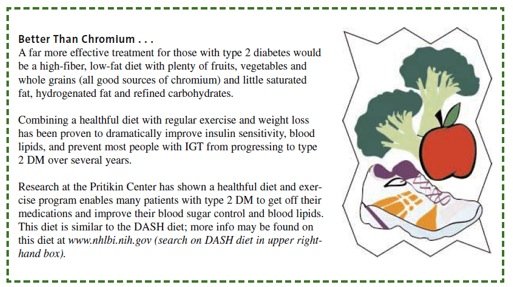
By James Kenney, PhD, RD, LD, FACN. References: 1 Med Sci Sports Exerc. 1996;28:139-44 2 Am J Clin Nutr. 1996;63:954-65 3 Fed Proc 1974;33:275-80 4. Diabetes Care. 2005;28:712-714
Nutrition Education Store
Look What's New in Our Store

Build-a-Plate Teaching Kit with Food ModelsView in store →

Meet the Kernel Whole Grain Replica BundleView in store →

Lunchtime Hero 3D Award Figure + Activity GuideView in store →

How Much Sugar? Test TubesView in store →

NEW! 3D-Printed Sugar Cubes: Stack the SugarView in store →

How Much Salt? Test TubesView in store →

How Much Fat? Test TubesView in store →

The New Pyramid Poster 2026 (18"×24")View in store →

New 2026 Food Pyramid TearpadView in store →

MyPlate Handout TearpadView in store →

Food Label Math Poster (18"×24")View in store →

Sip Smart Hydration TearpadView in store →

Are You Drinking Candy? Banner on Stand (24"×67")View in store →

MyPlate Portion Plates (Pack of 10)View in store →

Fruit & Vegetable Pens (Pack of 10)View in store →

Fruit-Shaped Note Pads (Pack of 10)View in store →

NEW! Eat Real Food Wristbands (Pack of 20)View in store →

NEW! Habit Stack Wristbands (Pack of 20)View in store →

NEW! Are You Drinking Candy? Wristbands (Pack of 20)View in store →