Margarine Update
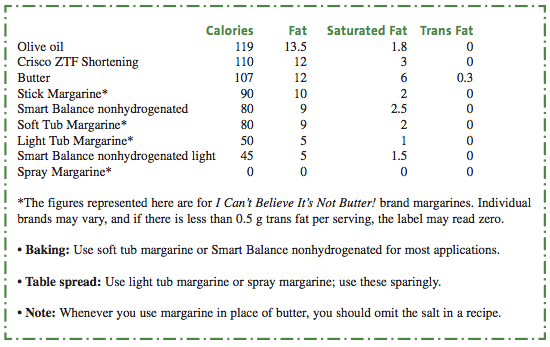 Many margarines are now touting ?0 g trans fat? and even Crisco Zero Trans Fat Shortening is a new option. Our adviser, Margaret Pfeiffer, MS, RD, asked us to look into this matter because her patients have been asking which fat is best.
Olive oil is lower in saturated fat and trans fat than butter but it is the most calorie-dense choice. It should be used sparingly for cooking and salads. The extra virgin variety contains the most flavor.We asked James Kenney, PhD, RD, LD, FACN, about the safety of the fats used in the new zero-trans-fat Crisco and margarines. He advises, ?We really have no good data I?m aware of to say whether or not this man-made fat would be safe long term. It may increase blood clotting. At the very least it would be very calorie dense and virtually devoid of nutrients. The last thing Americans need is something with a high energy density and low nutrient density. At least it would not be much worse in this regard than other solid fats like tropical oils, lard, beef tallow and partially hydrogenated oils. Even so, eating foods with this artificial fat would almost certainly promote weight gain and reduce the nutrient density of the diet. Weight gain and low nutrient and phytochemical content we know promotes insulin resistance and has adverse effects on blood lipids and immunity. Type 2 DM, CVD and cancer would all likely increase with the increased consumption of these man-made fats.?So the bottom line on all of these fats is choose low-cal soft tub margarine for your heart. And use it sparingly for your waist!
Nutrition Education Store
Look What's New in Our Store

Build-a-Plate Teaching Kit with Food ModelsView in store →

Meet the Kernel Whole Grain Replica BundleView in store →

Lunchtime Hero 3D Award Figure + Activity GuideView in store →

How Much Sugar? Test TubesView in store →

NEW! 3D-Printed Sugar Cubes: Stack the SugarView in store →

How Much Salt? Test TubesView in store →

How Much Fat? Test TubesView in store →

The New Pyramid Poster 2026 (18"×24")View in store →

New 2026 Food Pyramid TearpadView in store →

MyPlate Handout TearpadView in store →

Food Label Math Poster (18"×24")View in store →

Sip Smart Hydration TearpadView in store →

Are You Drinking Candy? Banner on Stand (24"×67")View in store →

MyPlate Portion Plates (Pack of 10)View in store →

Fruit & Vegetable Pens (Pack of 10)View in store →

Fruit-Shaped Note Pads (Pack of 10)View in store →

NEW! Eat Real Food Wristbands (Pack of 20)View in store →

NEW! Habit Stack Wristbands (Pack of 20)View in store →

NEW! Are You Drinking Candy? Wristbands (Pack of 20)View in store →