You don’t have to be the ‘biggest loser’
When you’re overweight or obese, the thought of losing enough pounds to achieve your “ideal” weight can be overwhelming. That’s why it’s important to remember that losing a relatively small amount of weight can have a large impact on your health.The Academy of Nutrition and Dietetics recommends setting a realistic weight-loss goal of up to 10% of your body weight (1). If you have risk factors for heart disease, like high blood pressure, high cholesterol, and high blood glucose, the Academy says that a 3%-5% weight loss can improve these risk factors. So for someone who weighs 175 pounds, a realistic goal would be to lose up to 17.5 pounds. But losing 5-9 pounds is enough to reap some health benefits.In a 2013 Evidence Report from the National Heart, Lung, and Blood Institute (NHLBI), experts outlined how modest weight loss affects indicators related to diabetes, heart disease, and high blood pressure (2).For people who are overweight or obese, but do not have type 2 diabetes:-Losing 5-12 pounds can reduce the risk of developing type 2 diabetes by 30%-60%.-Losing 7-18 pounds can improve triglycerides, “good” HDL cholesterol, and “bad” LDL cholesterol.-Losing 5% of your body weight can reduce blood pressure and cut down on the need for blood pressure medicationsFor people who are overweight or obese, and have type 2 diabetes:-Losing 2%-5% of your body weight reduces fasting glucose and HgA1c.-Losing 5%-10% of your body weight results in bigger reductions in HgA1c and decreases the need for diabetes medications.-Losing 5%-8% of your body weight increases “good” HDL cholesterol and decreases triglycerides.-Losing 5% of your body weight may allow you to take a lower dose of cholesterol medication.Authors of a more recent review of research on this topic are more cautious about the benefits of modest weight loss for those with type 2 diabetes (3). Their conclusion: Weight loss is more important for the prevention or delay of type 2 diabetes than for treating it.
While the biggest losers get all the attention, it’s clear that losing a relatively small amount of weight results in health benefits for those who are overweight or obese.
(1) Position of the Academy of Nutrition and Dietetics: Interventions for the treatment of overweight and obesity in adults. J Acad Nutr Diet. 2016;116:129-147. Online at http://dx.doi.org/10.1016/j.jand.2015.10.031.(2) National Heart, Lung, and Blood Institute. Managing Overweight and Obesity in Adults: Systematic Evidence Review from the Obesity Expert Panel, 2013. Online at www.nhlbi.nih.gov/sites/www.nhlbi.nih.gov/files/obesity-evidence-review.pdf.(3) Franz MJ et al. Lifestyle weight-loss intervention outcomes in overweight and obese adults with type 2 diabetes: A systematic review and meta-analysis of randomized clinical trials. J Acad Nutr Diet. 2015;115:1447-1463. Online at http://dx.doi.org/10.1016/j.jand.2015.02.031.Research Highlight:In a randomized controlled study of 40 obese subjects, a 5% weight loss significantly affected body fat in the abdomen and liver, insulin sensitivity, and beta cell function. Beta cells are found in the pancreas; they store and release insulin. Impaired beta-cell function is a risk factor for the development of type 2 diabetes. Greater weight losses of 11%-16% showed even more benefits in insulin sensitivity and beta cell function.Source: Magkos et al. Cell Metabolism. 2016;23:1–11. Online at http://dx.doi.org/10.1016/j.cmet.2016.02.005.By Hollis Bass MEd, RDN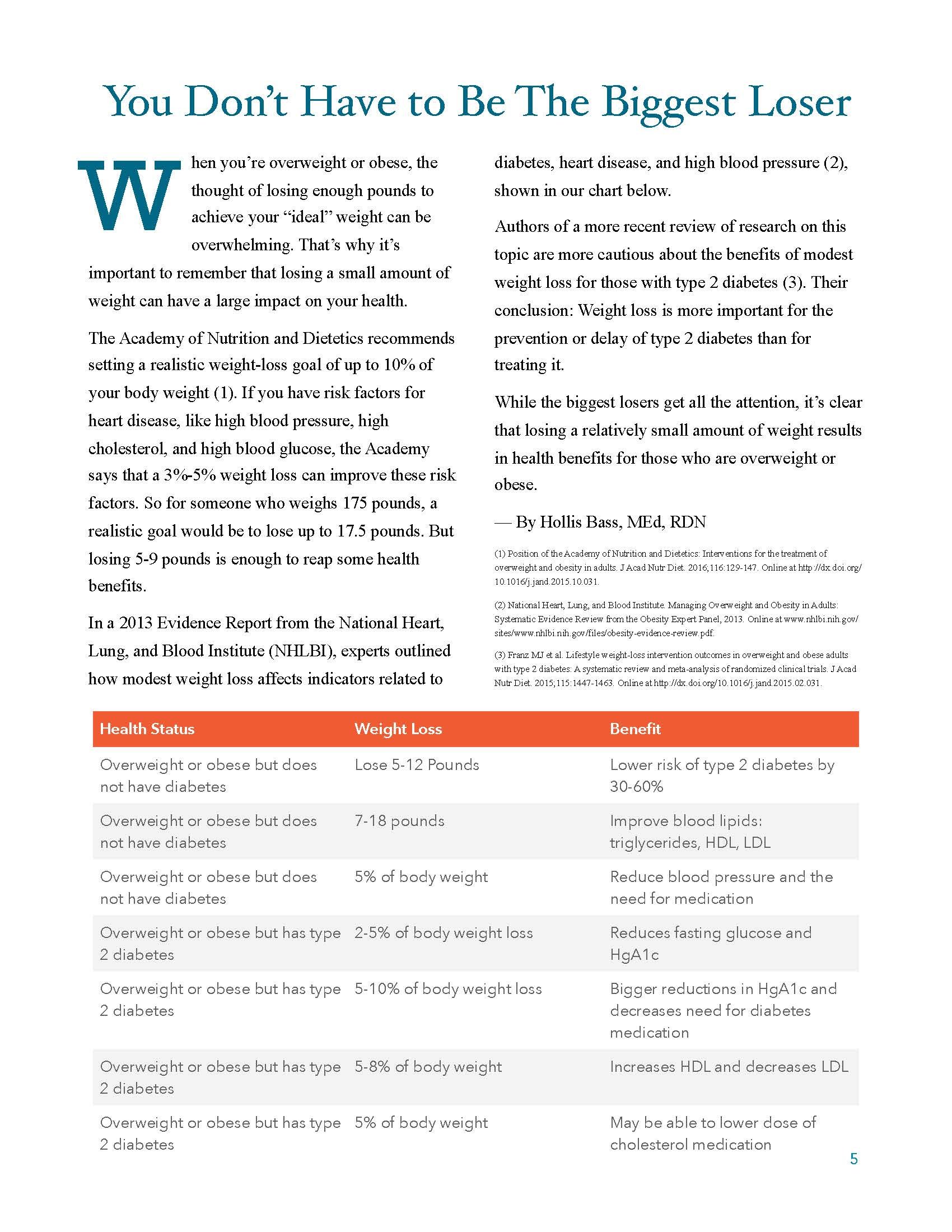
 Handout with article and chartHandout with infographicInfographic PDF
Nutrition Education Store
Look What's New in Our Store