

2005 Dietary Guidelines
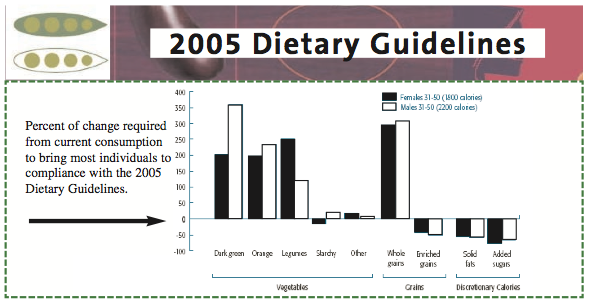 The Dietary Guidelines for Americans have been published. You can view them online at www.health.gov. The graph shown above is a good overview for what changes most adults need to make to go from where they are now to being compliant with the new guidelines. The bars above the zero signify an increase, while the bars below indicate a decrease:
- People need to eat more dark green and orange vegetables, legumes and whole grains.
- They need to eat fewer refined grains, solid fats and added sugars.
These changes would clearly help most people get an adequate amount of nutrients without excess calories.Here are a few important highlights out of the 84 page document:
- Dietary fiber should be 14 grams per 1,000 calories consumed.
- Consume less than 10% calories from saturated fat; keep fat consumption to 20-35% with most fats coming from fish, nuts and vegetable oils.
- Consume 3 or more ounce-equivalents of whole-grain products per day. At least half the grains should come from whole grains.
- Two cups of fruit and 2-1/2 cups of vegetables per day are recommended for a 2,000-calorie intake.
- Choose from the five veggie subgroups several times per week: dark green, orange, legumes/beans, starchy vegetables and other vegetables.
- Consume 3 cups per day of fat-free or low-fat milk or equivalent milk products.
- Consume less than 2,300 mg sodium per day. (This number goes to 1,500 for middle-aged Americans, Blacks and those with hypertension.) Additionally, the sixth version of the guidelines calls for more exercise:
- To prevent gradual, unhealthful body weight gain in adulthood: Engage in approximately 60 minutes of moderate- to vigorous-intensity activity on most days of the week.
- To sustain weight loss in adulthood: Participate in at least 60 to 90 minutes of daily moderate-intensity physical activity while not exceeding caloric intake requirements. Some people may need to consult with a healthcare provider before participating in this level of activity.
- Achieve physical fitness by including cardiovascular conditioning, stretching exercises for flexibility, and resistance exercises or calisthenics for muscle strength and endurance.
Nutrition Education Store
Look What's New in Our Store

Build-a-Plate Teaching Kit with Food ModelsView in store →

Meet the Kernel Whole Grain Replica BundleView in store →

Lunchtime Hero 3D Award Figure + Activity GuideView in store →

How Much Sugar? Test TubesView in store →

NEW! 3D-Printed Sugar Cubes: Stack the SugarView in store →

How Much Salt? Test TubesView in store →

How Much Fat? Test TubesView in store →

The New Pyramid Poster 2026 (18"×24")View in store →

New 2026 Food Pyramid TearpadView in store →

MyPlate Handout TearpadView in store →

Food Label Math Poster (18"×24")View in store →

Sip Smart Hydration TearpadView in store →

Are You Drinking Candy? Banner on Stand (24"×67")View in store →

MyPlate Portion Plates (Pack of 10)View in store →

Fruit & Vegetable Pens (Pack of 10)View in store →

Fruit-Shaped Note Pads (Pack of 10)View in store →

NEW! Eat Real Food Wristbands (Pack of 20)View in store →

NEW! Habit Stack Wristbands (Pack of 20)View in store →

NEW! Are You Drinking Candy? Wristbands (Pack of 20)View in store →