How to Read a Food Label — Free Printable PDF Guide
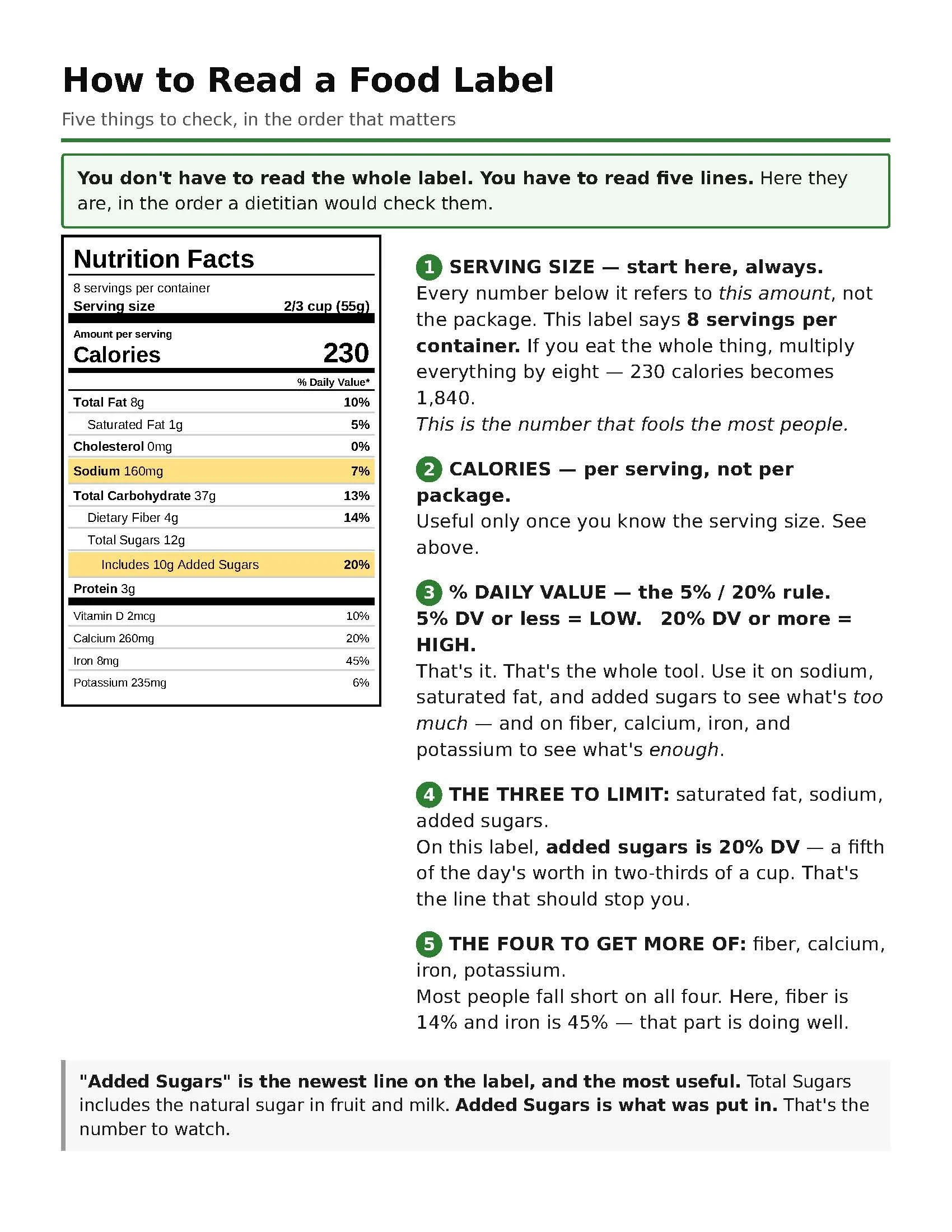
You don't have to read the whole label. You have to read five lines.
1. Serving size — always start here. Every number below it refers to that amount, not the package. A label saying 230 calories and "8 servings per container" means the box holds 1,840 calories. This is the number that fools the most people.
2. Calories — per serving. Only useful once you know the serving size.
3. % Daily Value — the 5%/20% rule. 5% or less is LOW. 20% or more is HIGH. That's the whole tool.
4. The three to limit: saturated fat, sodium, added sugars.
5. The four to get more of: fiber, calcium, iron, potassium. Most people fall short on all four.
The claims on the front are not the label
"Reduced sodium" means 25% less than the regular version — which can still be very high. A comparison, not a promise.
"Made with whole grain" means almost nothing. It could be 2% whole grain. Read the ingredient list.
"Natural" is not a regulated term for most foods.
Read the ingredient list — it's ranked by weight
If sugar is in the first three, it's a sugary food, whatever the front says. Sugar has many names — anything ending in -ose, or the words syrup or sugar: high-fructose corn syrup, cane sugar, agave, honey, molasses, fruit juice concentrate.
The simplest test of all: could you make this food in your own kitchen, with ingredients you recognize? If not, it's ultra-processed.
FAQ
What is the 5/20 rule? 5% Daily Value or less is low; 20% or more is high. What should I look at first on a food label? The serving size. Everything else depends on it. What is the difference between total sugars and added sugars? Total sugars includes natural sugar from fruit and milk. Added sugars is what was put in — that's the number to watch. Does "reduced sodium" mean low sodium? No. It means 25% less than the original, which can still be very high.
Nutrition Education Store
Look What's New in Our Store